James Blake. Real creativity has no shortcuts
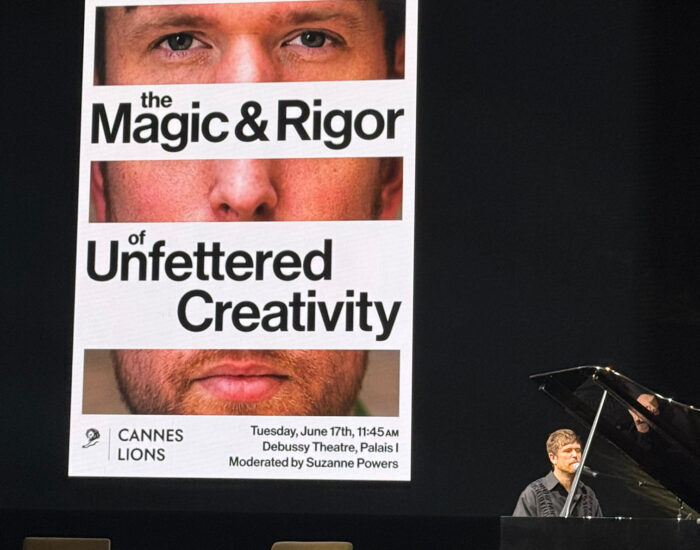
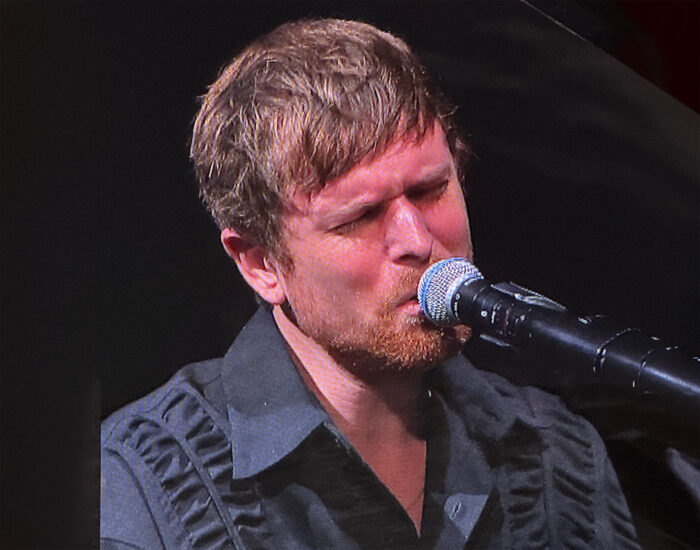
At Cannes Lions 2025, James Blake, the musician and producer made an argument that cut against nearly everything else said onstage that week : depth matters more than speed, and no tool — however powerful — can replace the process that makes creative work worth making.
Story
Reto Bloesch, Patrick Weiss, Stefan Jermann
Photography
Reto Bloesch
James Blake did not arrive at the Palais des Festivals with a product to sell or a platform to announce. He arrived with a position — and it ran directly counter to the mood in the room. While the rest of Cannes was debating how artificial intelligence would reshape the advertising industry, Blake was making a quieter, more uncomfortable case: that the creative shortcuts everyone is racing to take may be costing them the very thing they are trying to produce.
Blake, whose work as a producer and recording artist spans more than a decade of critically acclaimed output, is not reflexively opposed to technology. But he is skeptical of the speed at which the industry has decided that tools can substitute for process — and he speaks from experience about what gets lost when they do.
The Long Way Is the Point
Blake built his own creative foundation over years before digital tools became central to his practice. That sequence, he argued in Cannes, was not incidental. It was the whole thing. “If you take shortcuts,” he told the audience, “you skip the process that actually makes you better.”
The statement landed simply, but its implications run deep. The friction of learning — the failed attempts, the slow accumulation of judgment, the years of not quite getting it right — is not inefficiency to be optimized away. It is the mechanism through which craft develops. Tools can support that process. They cannot replace it. And when they are introduced before the foundation exists, they tend to accelerate the production of work that looks finished but isn’t.
Collaboration as Productive Discomfort
On the subject of working with others, Blake was unusually candid. For much of his career, he said, collaboration felt like something to be managed rather than embraced. Too many perspectives. Too little control. “I often hated collaboration — because it’s uncomfortable,” he said. The admission got a laugh, and then a silence that suggested it had landed somewhere true.
What changed his view was not a revelation but an accumulation of evidence. The work that came out of genuine creative friction — the kind that required him to defend his instincts, concede on some and hold firm on others — tended to exceed what he could produce alone. “When you set your ego aside,” he said, “the result becomes bigger than yourself.”
It is a principle that applies beyond music. In any creative discipline, collaboration forces a confrontation with the limits of individual perspective. That confrontation is uncomfortable by design. It is also, Blake argues, where the most durable work tends to originate.
“People connect with honesty, not perfection.”
What AI Cannot Do
Blake’s remarks on artificial intelligence were precise rather than sweeping. He acknowledged the technology’s potential without inflating it. What he questioned was the assumption, increasingly common in the industry, that AI’s capacity to accelerate output translates into creative value.
“AI should be giving us time,” he said. “Instead, it often feels like it’s putting us under more pressure.” The observation points to a structural problem: when a tool increases the volume of what can be produced, the instinct is to produce more, not to produce more carefully. The efficiency gain becomes a new demand, not a reprieve.
More fundamentally, Blake drew a line between process and feeling. “Technology can accelerate processes,” he said. “But it cannot generate real emotion.” That distinction matters because emotion, in his view, is not an aesthetic quality layered onto finished work — it is what determines whether the work reaches anyone at all. Automate the process, and you risk automating away the only thing that makes the output matter.
Connection Over Output
The standard Cannes conversation tends to orbit reach, impact, and measurable return. Blake reoriented the frame. What counts, in his telling, is not volume of production but what actually registers with another person — and that registration depends less on technical execution than on a quality he calls honesty.
Creativity, for Blake, is not an output category. It is a moment of contact between the person who made something and the person who receives it. That contact requires the maker to put something real into the work — something that came from experience, not from a prompt. “People connect with honesty, not perfection,” he said. It was the line the room seemed to hold onto longest.
Slower, Deeper, More Human
Blake offered no framework, no formula, no five-step approach to better creative work. What he offered was a disposition: slow down, go deeper, resist the pull toward the efficient and the frictionless.
“The things that truly mean something take time,” he said in closing. Good work is not produced by speed. It is produced by understanding — of the material, of the audience, of oneself. And the understanding that matters most cannot be outsourced.
In a week defined by speculation about what machines will soon be able to do, Blake’s contribution was a reminder of what they cannot: feel something, mean it, and make someone else feel it too.