Giants no longer dance
Why bigger is not better
Sir John Hegarty is a regular at the Lions. This time he didn’t come to celebrate the advertising industry, but to challenge it and to argue that the moment we are living through demands a different kind of ambition entirely.
Bigger in this case is not better and here is why.
Story
Reto Bloesch, Stefan Jermann, Patrick Weiss
Photography
Stefan Jermann
There is a particular kind of authority that comes not from a title but from having been right before. Sir John Hegarty, co-founder of Bartle Bogle Hegarty and one of the most decorated creative minds in the history of advertising, walked onto the Cannes Lions stage and opened with a provocation that silenced the room: “Size is no longer a strategic advantage. It is bureaucracy.”
What followed was not a retrospective and not a victory lap. It was a diagnosis and, embedded within it, a challenge to every large organization in the audience to examine what it has traded away in the pursuit of scale.
The Gutenberg Moment
Hegarty’s central frame for the current technological shift is historical rather than technical. Artificial intelligence, he argued, is “our Gutenberg moment” — a rupture in the distribution of knowledge and capability that changes not just tools but power structures. The printing press did not merely accelerate the production of books. It dismantled the monopoly on information that had sustained institutions for centuries. Hegarty believes AI is doing the same thing to creative and commercial expertise.
The beneficiaries, in his telling, are not the incumbents. They are the small, focused, fast-moving operators who can use AI as leverage precisely because they are not slowed by complexity, internal alignment processes, or the organizational drag that accumulates inside large enterprises. “The giants,” he said, “can no longer dance.”
Turn the Pyramid Upside Down
Hegarty has little patience for the conventional corporate hierarchy, and at Cannes he said so plainly. “We need to stop thinking of companies as pyramids,” he argued, proposing instead an inverted model in which leadership’s primary function is not control but the creation of conditions in which talent can operate freely. “The talent sits at the bottom,” he said. “That is where ideas are made. That is where value is created.”
AI accelerates this inversion. When capabilities that once required years of specialist training become broadly accessible, the competitive advantage of organizational hierarchy diminishes further. What remains — and what Hegarty believes will increasingly separate successful companies from unsuccessful ones — is the one thing that cannot be systematized. “Creativity,” he said, “is the last differentiator.”
Philosophy Before Everything Else
The section of Hegarty’s talk that generated the most discussion was not about technology. It was about identity. “Great brands start with a philosophy,” he said. “Everything else follows.” He pointed to Patagonia and Oakley as companies that succeeded because they were built from a clear conviction — not from a market opportunity, not from a spreadsheet, but from a belief about what they stood for.
The problem, as Hegarty frames it, is that growth tends to erode that clarity. Processes accumulate, ideas get displaced, and brands become interchangeable. The original conviction that animated the company gets buried under layer upon layer of professional management.
Here he introduced AI in a way that few others at Cannes had considered. “Maybe AI can help us remember who we actually are,” he said — positioning the technology not as an efficiency engine but as a form of institutional memory, capable of preserving and reactivating the founding philosophy that growth tends to obscure.
Sir John Hegarty says:
- Reject size as a proxy for strength.
Large organizations that mistake scale for competitive advantage are already losing ground to smaller, faster operators. The structural weight that once protected incumbents now slows them. Agility, focus, and the willingness to move quickly have replaced headcount as the markers of durability.
- Build from philosophy, not from process.
The companies Hegarty admires most — Patagonia, Oakley, BBH itself — were founded on a conviction about what they stood for. That conviction preceded strategy, preceded product, preceded market research. Without it, brands become interchangeable. With it, they endure.
- Treat AI as a collaborator, not a shortcut.
Hegarty’s most pointed warning was aimed at organizations that approach AI purely as a productivity tool. That framing is too small. Used well, AI can extend creative reach, preserve institutional memory, and open possibilities that no individual could pursue alone. Used carelessly, it accelerates the production of the ordinary.
What If Bernbach Were Still in the Room?
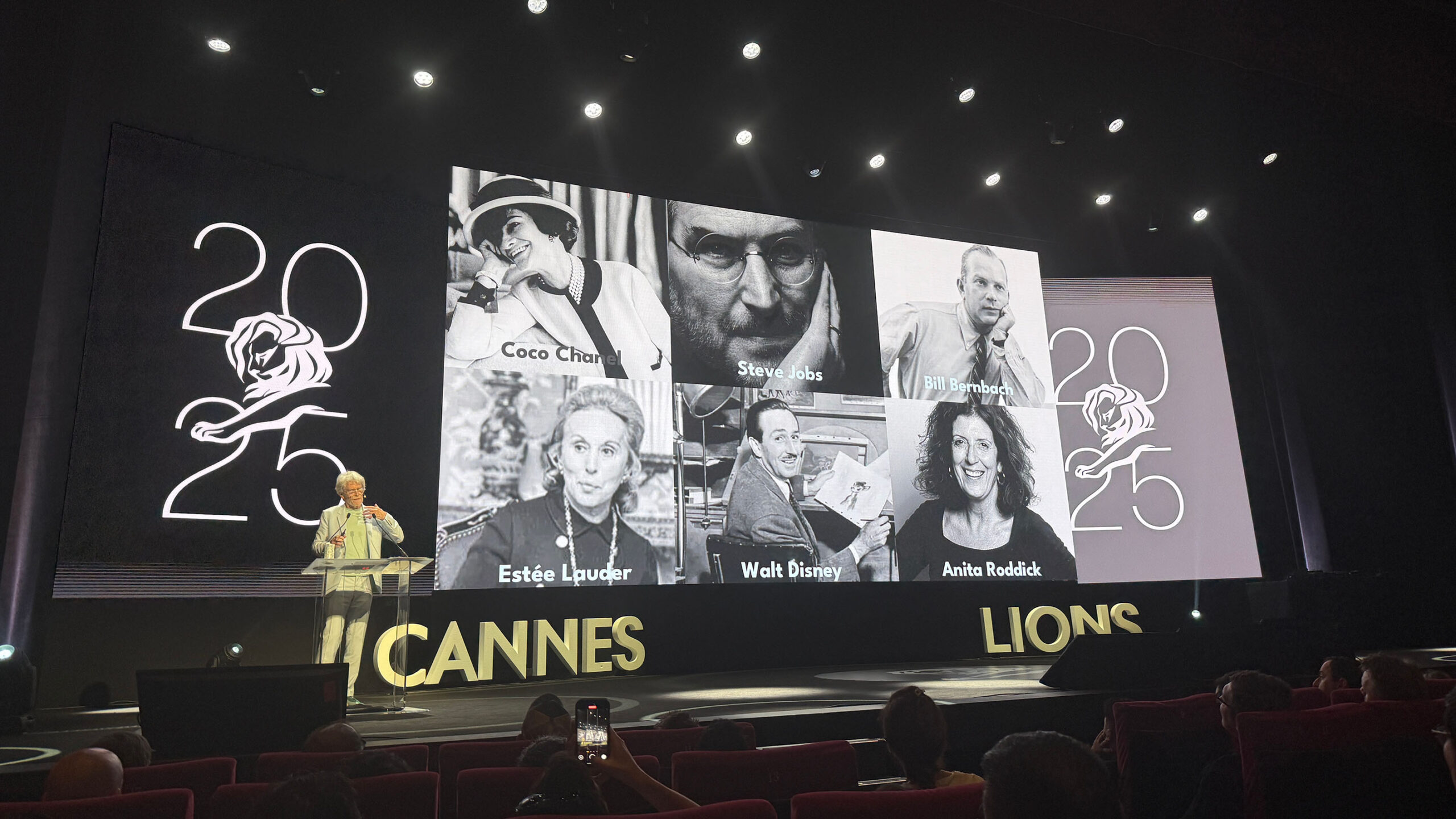
One of the more striking ideas Hegarty floated at Cannes was speculative but pointed. “What if you could speak with Coco Chanel today?” he asked. “Or with Bill Bernbach?” The question was not nostalgic. It was structural. Hegarty was suggesting that AI might allow founding philosophies to remain active within organizations long after their originators are gone — not as static archives but as dynamic voices capable of engaging with new problems.
“This is how a company’s belief stays alive,” he said, “and stays adaptable.” Identity, in this model, is not preserved but extended — a form of continuity that moves forward rather than looking back.
“Money is a tool. It is not a philosophy.”
Sir John Hegarty
Money Is a Tool. It Is Not a Philosophy.
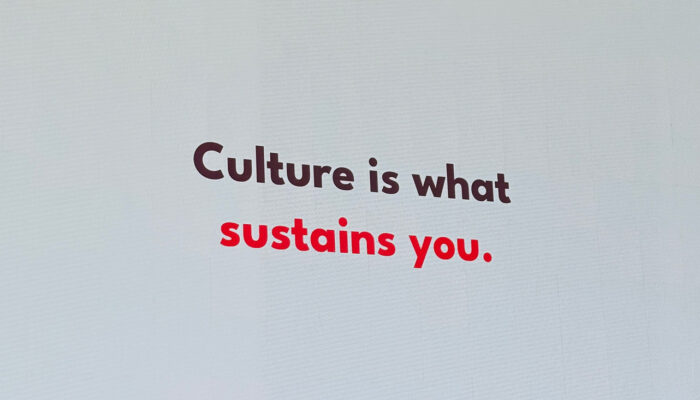
Asked what advice he would give his younger self, Hegarty did not hesitate. “I would start my own company immediately,” he said. The more important point came next. “Money is a tool. It is not a philosophy.” What makes organizations last — truly last, across technological shifts, economic cycles, and generational change — is culture. He pointed to Polaroid and Kodak as cautionary examples: companies with enormous technical capability and cultural cachet that disappeared because they failed to sustain the internal conditions that had generated their original advantage.
Bolder, Not Bigger
Hegarty closed with a statement that crystallized the argument he had been building for an hour. “In the future, a single person will be able to build a billion-dollar company,” he said. AI makes that possible. But the point, he insisted, is not the billion dollars. “The goal is not to get bigger. The goal is to get bolder.”
It was a rebuke, gently delivered, to an industry that has spent decades conflating ambition with scale. The organizations that will navigate this moment well, Hegarty suggested, are not the ones with the largest infrastructure or the most sophisticated AI deployment. They are the ones that remain clear about what they believe — and courageous enough to act on it.
“See AI as a collaborator,” he said in his final line — not a replacement, not a threat, not a shortcut. A partner in the pursuit of work that is genuinely worth making.