In the Age of the Algorithm
Apple’s CMO has a different answer
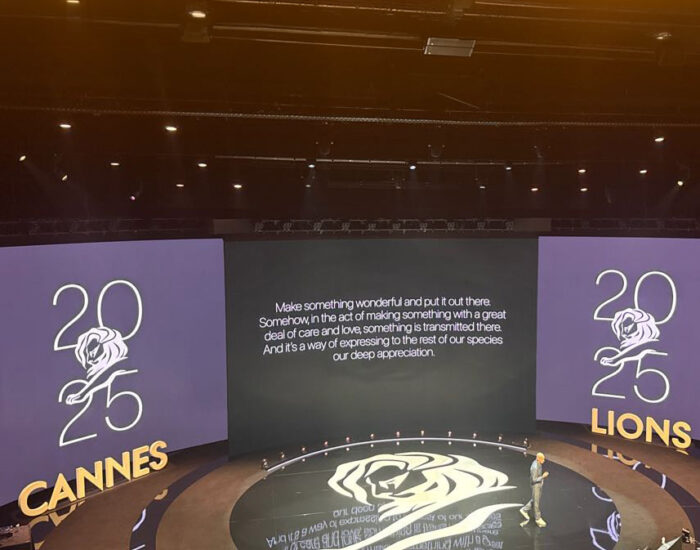
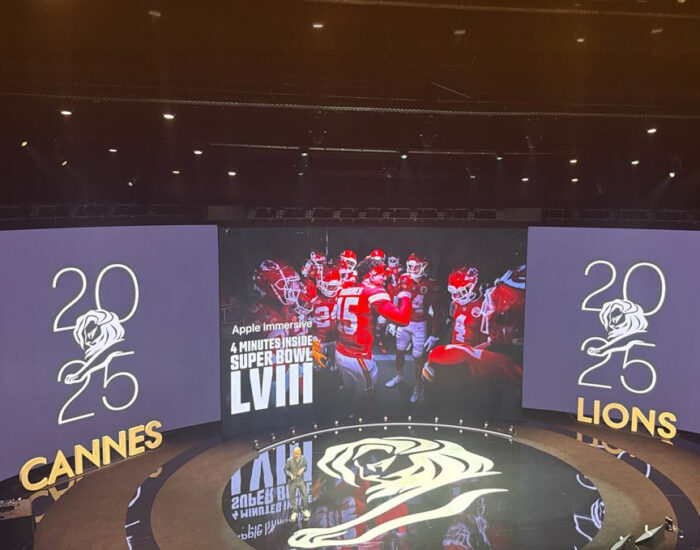
The room had been talking about artificial intelligence for three days straight. Panels, keynotes, poolside conversations, during the Cannes Lions 2025, the same anxious question circling the Palais des Festivals like a rumor that wouldn’t die: what, exactly, is left for humans to do? Then Tor Myren walked onto the stage, and he didn’t answer the question. Not right away.
Myren, Apple’s Vice President of Marketing, rarely appears at industry conferences. His presence at Cannes Lions this year was itself a signal. What he delivered — part manifesto, part provocation, part quiet corrective to the industry’s escalating panic — was among the most closely watched sessions of the week.
Story
Stefan Jermann, Patrick Weiss, Reto Bloesch
Photography
Courtesy of Apple
Cannes Lions Stage by Stefan Jermann
From the Spec Sheet to the Story
The AirPods campaign Myren described did not begin, as most product launches do, with a list of technical capabilities. It began with a question that sounds almost naïve in a room full of performance marketers: what does this change in someone’s life?
The answer, in this case, was profound. Apple had quietly engineered AirPods into clinical-grade hearing aids: a feat of medical and acoustic engineering that most companies would announce with a press release, a chart, and a decibel range. Apple, under Myren’s direction, found a father who could hear his family again. They found a bedroom. A closet. The sound of children playing downstairs, muffled through years of gradual loss, suddenly returned. “The emotional resonance of a father hearing clearly through his son’s AirPods,” Myren told the audience, “matters more than any feature list ever could.”
It is, of course, a classic Apple move. And yet it illuminates something the industry keeps forgetting in its race toward efficiency: features are forgotten; feelings are not.
The Sidekick No One Asked For
Myren is not a technophobe. He called artificial intelligence “mind-blowing” — a “bionic arm” for creatives — and made clear that it is already embedded in Apple’s creative process at every stage. Exploration, adaptation, production: AI accelerates all of it. He has no interest in the Luddite critique.
“Logic alone is not the path to brand love.”

But he is equally uninterested in the techno-utopian one. AI, as he frames it, is a sidekick: brilliant, fast, tirelessly useful — and constitutionally incapable of the thing that makes advertising work. It cannot feel embarrassed by a bad joke. It cannot sense when a performance is almost right but not quite. It cannot decide, from somewhere beneath reason, that this story deserves to be told. Those judgments remain stubbornly, irreducibly human.
The Texture of Things
Even as Apple ventures into Apple Vision Pro and the frontier of spatial computing, Myren’s instinct runs counter to the drift toward the frictionless and the virtual. He spoke at length about the “bird cam” creatures built for a privacy campaign — hand-constructed, lifelike, deliberately imperfect — as emblematic of a broader philosophy: that in an increasingly synthetic world, what reads as human is texture, timing, the small tremor of something real.
It is an argument that extends beyond advertising. As generated imagery proliferates and audiences become quietly fluent in the visual grammar of AI, the things that feel made — labored over, chosen, slightly flawed — will carry a different weight. Craft, in this reading, is not nostalgia. It is strategy.
The Platform, Not the Megaphone
The “Shot on iPhone” campaign, now a decade old and still expanding, is perhaps the clearest expression of Myren’s broader worldview. Apple does not simply market to its users; it creates conditions in which users market with it. Millions of photographs, films, and stories have poured through that single brief. The brand’s role, as Myren describes it, is to provide the tools, amplify the voices, and then step back far enough that genuine human creativity can take the frame.
The App Store developer song extended the same logic into music. The instinct, in both cases, is less about control than about catalysis. Apple positions itself not as the storyteller but as the reason the story could be told at all.
The Long Way Is the Point
Blake built his own creative foundation over years before digital tools became central to his practice. That sequence, he argued in Cannes, was not incidental. It was the whole thing. “If you take shortcuts,” he told the audience, “you skip the process that actually makes you better.”
The statement landed simply, but its implications run deep. The friction of learning — the failed attempts, the slow accumulation of judgment, the years of not quite getting it right — is not inefficiency to be optimized away. It is the mechanism through which craft develops. Tools can support that process. They cannot replace it. And when they are introduced before the foundation exists, they tend to accelerate the production of work that looks finished but isn’t.
The Game That’s Still Ours
Tor Myren closed his session with something closer to reassurance than triumphalism. The industry, he acknowledged, is frightened — about jobs, about relevance, about what happens when the machines get fast enough. He does not dismiss the anxiety. He simply declines to accept its conclusion.
“Creativity,” he told the room, “is still the game we can win.” Data informs. Algorithms optimize. But only people can make work that makes other people laugh, or cry, or fall in love. The future belongs to those who use artificial intelligence to move faster — and trust their own judgment to decide where to go.
In Cannes, where the conversation about AI had grown so loud it was starting to drown out everything else, that was a quieter kind of provocation. The human touch, Myren was saying, doesn’t merely survive the machine age. In the end, it leads it.